
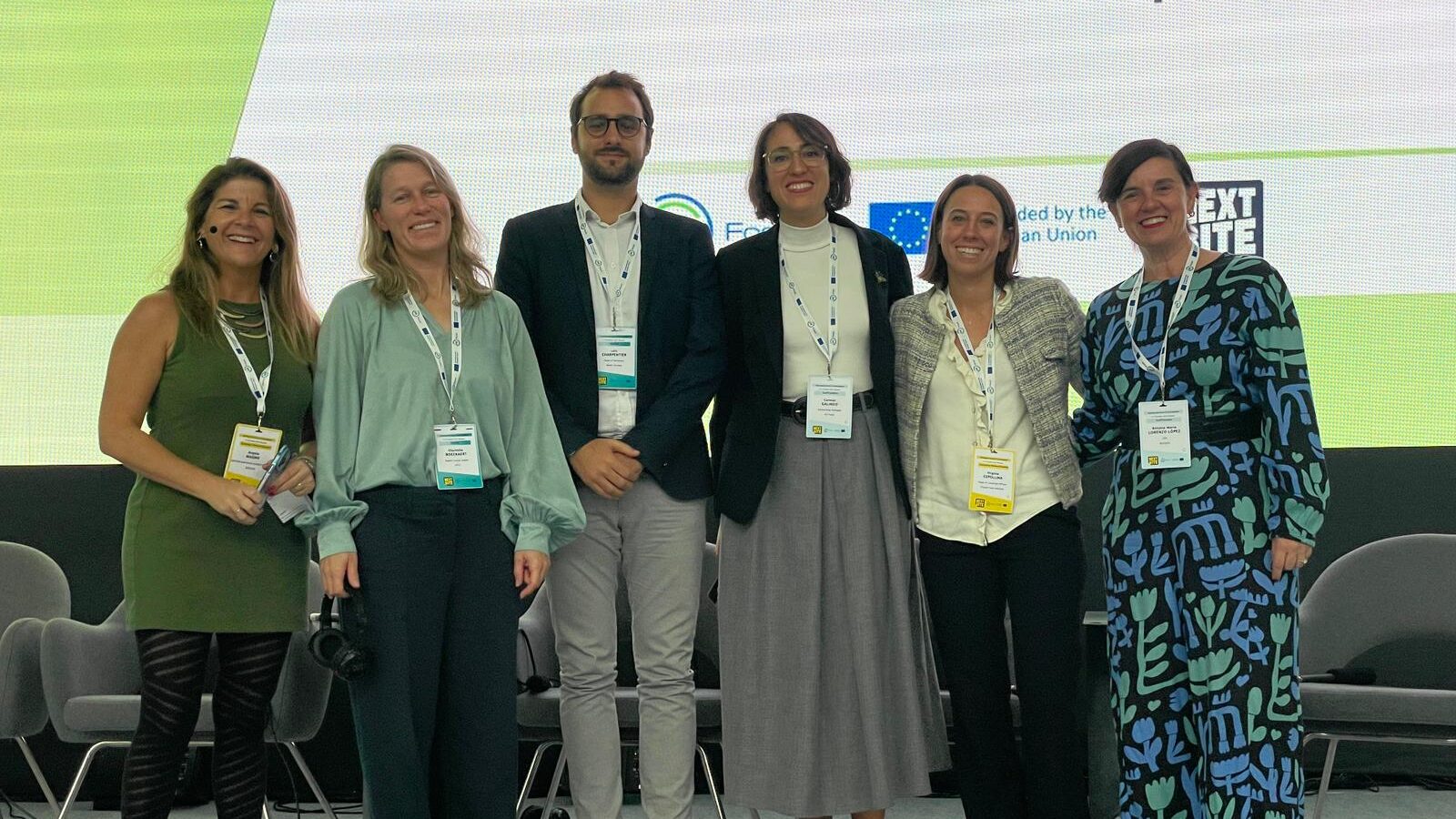
On 15 October 2025, the BOOST-IN project, coordinated by BIOAZUL, took part in EIT Food’s NEXT BITE 2025 event in Brussels, a leading European forum that brings together innovators, policymakers, researchers, and entrepreneurs to explore the future of the food system. The event aims to accelerate Europe’s transition towards a Net Zero, resilient, and fair agri-food system, creating a dynamic platform for collaboration and knowledge exchange.
At the Net Zero Food System Stage, BIOAZUL organised and moderated the session “Water Wise Futures: Circular, Smart & Inclusive Agri-Food Systems”, a discussion perfectly aligned with BOOST-IN’s vision of advancing the Water Circular Economy across Europe. The session explored how circular approaches, innovative technologies, and inclusive strategies can transform water use and governance throughout the agri-food value chain.
Linking innovation, governance, and inclusion
The session was moderated by Ángela Magno, BIOAZUL’s Director of Communication and Marketing Strategy, and featured a keynote by Antonia Lorenzo, CEO of BIOAZUL and coordinator of BOOST-IN. The panel brought together key voices from across Europe: Charlotte Boeckaert (VITO), Carmen Galindo (EIT Food South), Virginia Cepollina (Future Food Institute), and Loïc Charpentier (Water Europe), who also represents BOOST-IN’s policy work package.
Antonia Lorenzo opened the session with a strong message on the importance of water governance, equity, and systems thinking. She reminded the audience that agriculture consumes around 70% of global freshwater, yet those who rely on it the most—women, smallholder farmers, and local communities—are often excluded from decision-making. She stressed that addressing Europe’s water and food challenges requires integrated governance models that combine environmental, social, and economic dimensions.
Her presentation highlighted regenerative agriculture as a cornerstone of resilience, showing how practices such as cover cropping, composting, and agroforestry can restore soil health, retain water, and reduce dependence on chemical inputs. Antonia also emphasised the need for governance frameworks and incentives that reward circular practices and ensure gender inclusion in decision-making. These principles are at the core of BOOST-IN’s mission: promoting systemic change, resource recovery, and inclusive governance across Europe’s water and agri-food sectors.
From innovation to real-world adoption
The panel discussion offered diverse perspectives on how Europe can accelerate the uptake of Water Circular Economy Solutions (WACES), a key focus area for BOOST-IN.
Carmen Galindo from EIT Food showcased programmes that de-risk innovation and connect farmers with startups developing water-smart solutions, such as Test Farms and the Water Scarcity Initiative. Charlotte Boeckaert shared a successful case of industrial wastewater reuse for irrigation in Belgium, where a 150,000 m³ buffer basin and a 500-hectare irrigation network reduced energy use and maintained crop quality for 50 farmers.
Virginia Cepollina from the Future Food Institute highlighted the human and social dimensions of innovation, presenting the story of AlmaSerum, a women-led startup that transforms dairy by-products into low-emission proteins for cosmetics and biomedical applications, achieving 100% water recovery and saving 2 million kilograms of CO₂ annually.
Finally, Loïc Charpentier from Water Europe, who leads the policy and advocacy activities within BOOST-IN, connected the discussion to the European policy context. He underlined the importance of national CAP plans, the revised Water Reuse Regulation, and EU research and innovation projects—such as BOOST-IN—in enabling a circular water transition. He stressed that to be effective, technological innovation must be supported by strong governance frameworks and policy instruments that foster collaboration across regions and sectors.
Inclusion and collaboration as engines of change
Throughout the session, the speakers converged on a shared message: inclusion must be embedded in governance, not treated as a side goal. Co-creation and participatory design, where farmers, entrepreneurs, and communities are active decision-makers, lead to higher adoption rates and greater long-term impact.
As the session concluded, participants agreed that the future of sustainable agri-food systems depends on an ecosystemic approach that connects water, food, energy, and ecosystems—the same integrative vision that drives the BOOST-IN project.