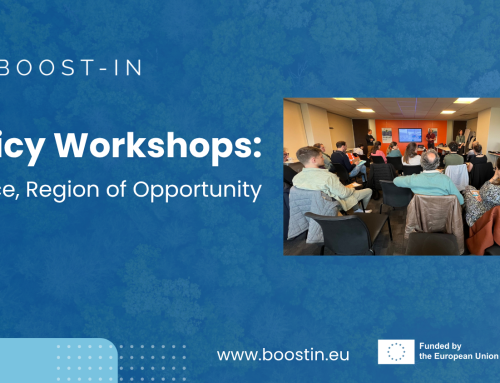


On 4 June 2026, the BOOST-IN project held a policy workshop in Sofia focused on the Bulgarian Region of Opportunity – Srednogorie. The workshop brought together representatives from national authorities, water utilities, industry, research and academia, environmental organisations, and business support organisations to discuss how policy can accelerate the uptake of Water Circular Economy Solutions (WACES) in Bulgaria.
Organised by the Bulgarian Water Association (BWA), the workshop provided a platform to validate barriers previously identified through BOOST-IN activities and to co-develop practical policy recommendations for the wider implementation of circular water solutions.
Srednogorie is characterised by a strong industrial presence, particularly in the mining and metallurgical sectors, alongside agricultural and local communities that depend on sustainable water management. Against a backdrop of increasing water scarcity, drought and competition for water resources, improving water efficiency and supporting water reuse are becoming increasingly important for the region.
Key barriers to WACES uptake
During the workshop, participants assessed and prioritised barriers affecting the implementation of circular water solutions. Discussions showed that governance, institutional and technological barriers are among the most significant constraints, while regulatory, economic and social challenges also play an important role.
Several priority issues emerged:
- Long-term strategic planning and institutional coordination: Participants highlighted the lack of long-term planning, overlapping responsibilities and insufficient coordination among public authorities as major obstacles to integrated water management.
- Institutional capacity and knowledge: Limited institutional capacity and insufficient knowledge of water reuse among policymakers can make it more difficult to develop and implement effective policies.
- Regulatory uncertainty: A lack of clarity regarding water reuse schemes and implementation guidelines, together with the evolving relationship between national and EU requirements, can create uncertainty for operators and investors.
- Technological validation and skills: Participants pointed to the need for more consistent validation of innovative technologies, as well as specialised training and capacity building for operators and technical staff.
- Economic attractiveness: Limited demand for reclaimed water and the comparatively low cost of conventional water sources can reduce incentives to invest in water reuse and circular water projects.
- Social acceptance and stakeholder engagement: Greater involvement of communities and stakeholders in planning and decision-making was identified as important for building trust and improving acceptance of innovative water reuse solutions.
From barriers to policy action
The workshop went beyond identifying challenges, with participants discussing policy measures capable of creating a more supportive environment for WACES.
A central message from the discussions was that the barriers are closely interconnected. Wider uptake of circular water solutions will therefore require coordinated action across governance, regulatory, institutional, technological, economic and societal dimensions.
Strengthening institutional cooperation, improving regulatory certainty, enhancing technical capacity and increasing stakeholder engagement were identified as important priorities for Bulgaria. Participants also underlined that technological solutions for water reuse and circular water management are increasingly available, but their successful implementation often depends on having the right policy and institutional conditions in place.
The outcomes of the Srednogorie workshop will contribute to BOOST-IN’s work on evidence-based policy recommendations, supporting the transition towards a more circular, resource-efficient and resilient water sector in Bulgaria and across Europe.