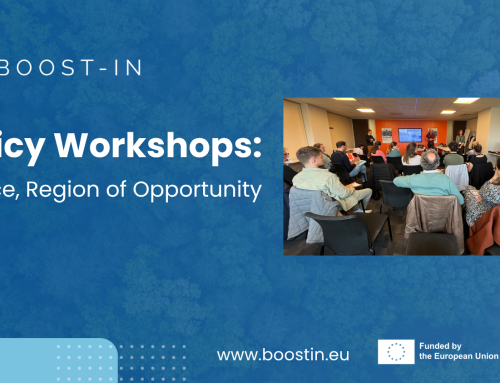

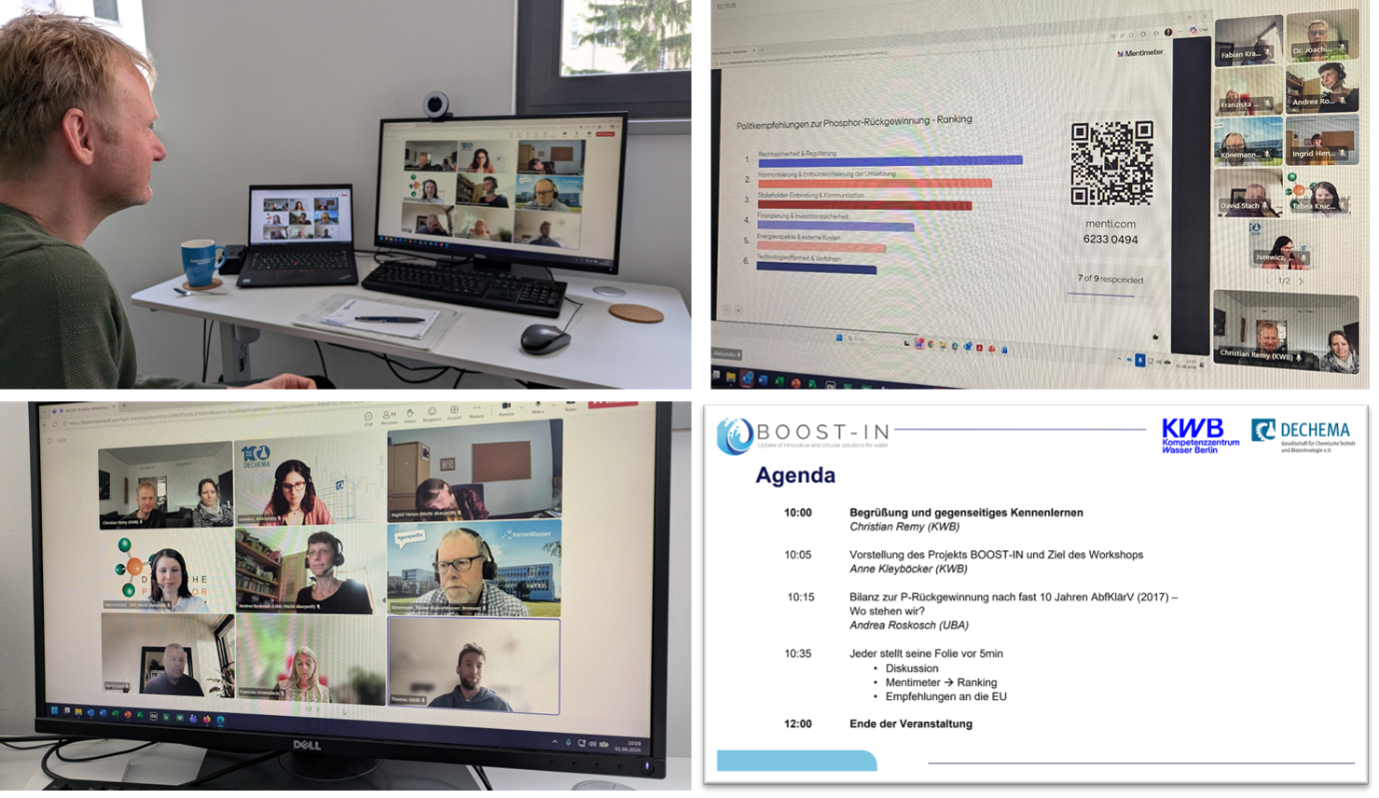
The BOOST-IN project aims to bridge the gap between research and the uptake of circular economy solutions in the water sector. The German BOOST-IN Region of Opportunity covers Lower Saxony and focuses on the recovery of nutrients and energy. To this end, a policy workshop was held to provide policy recommendations.
Germany’s Sewage Sludge Ordinance (AbfKlärV 2017) requires the recovery of phosphorus (P) from wastewater in order to close nutrient cycles and reduce reliance on imports. From 2029, large wastewater treatment plants (with a capacity of ≥100,000 population equivalents) will be required to recover phosphorus from wastewater, mainly through recovery from sludge or incineration ash. In an impact assessment for Lower Saxony, KWB compared sludge-based and ash-based recovery routes. They found that, although sludge-based processes have lower recovery rates, they also have a low carbon footprint and produce struvite, which is low in heavy metals. However, current regulatory requirements, particularly the strict maximum threshold targets for residual phosphorus content in sludge after recovery, mean that many operators favour ash-based routes, even though ash-based technologies are not yet operating at full scale. Emerging processes such as PECO and iPHOS have the potential to enhance sludge-based phosphorus recovery rates, but are difficult to implement due to the current regulatory framework and trends.
At EU level, phosphorus recovery was indirectly addressed in the EU Urban Waste Water Treatment Directive (UWWTD) by enshrining the principle of closed-loop systems and incorporating stricter requirements for nutrient concentrations in effluent from treatment plants. These stricter requirements lead to an accumulation of phosphorus in sewage sludge, thereby improving the economic conditions for phosphorus recovery. Regarding resource recovery, Article 20 empowers the EC to define dedicated minimum rates for mandatory P recovery from wastewater in a delegated act for all member states, to be delivered in 2028. The revised UWWTD came into force on 1 January 2025. Member States have until 31 July 2027 at the latest to transpose it into national law.
The aim of the policy workshop was to discuss, what the German stakeholders have learned from the implementation of the AbfKlärV (2017) after almost 10 years of development in this field, and what policy recommendations can be derived for the German government, but also for the EC and the individual EU Member States for the national implementation of the UWWTD in their countries. In particular, the recommendations can also feed into the on-going political process of setting up the delegated act for EU-wide minimum P recovery rates as mentioned above. This aligns with the current work of JRC to draft a recommendation for the content of the delegated act within its expert groups.
Stakeholders representing both the European and German perspectives, such as representatives from the German Environment Agency, the Senate for the Environment of Berlin, the German Wastewater Association, the German Phosphorus Platform, water utilities, wastewater treatment plant operators, the fertiliser sector, and water circular economy solution providers, as well as research organisations, came together to present and discuss their recommendations. The main outcomes were:
Recommendation 1: Legal certainty and regulation
Establish clear rules regarding the end-of-waste status of ash, sewage sludge and recyclates, considering an automatic end-of-waste status for very small amounts of recyclates. Maintain the mandatory P recovery strategy in Germany for WWTPs with a capacity of 100,000 PE or more, and prevent economic disadvantages for early adopters/first movers.
In Germany, the main focus in terms of phosphorus (P) recovery was on the sewage sludge ordinance. However, other areas, such as the legal framework for raw wastewater, are also important, and the wastewater ordinance should be considered for amendment. Ideally, sewage sludge should be less contaminated to make processes that do not eliminate heavy metals, for example, more applicable. Therefore, stricter requirements for indirect discharge could help to achieve this.
Recommendation 2: Harmonizing & reducing bureaucracy of the implementation
Align the German sewage sludge ordinance (AbfKlärV 2017) with the German fertiliser regulation (DüMV 2012), for example by considering not only the very strict water solubility for struvite but also neutral ammonium citrate (NAC) solubility, as this better reflects the actual plant availability of struvite. Harmonise German regulations with EU regulations and directives, such as the new UWWTD, and simplify the CE certification process according to the Fertilising Products Regulation (2019/1009).
The FPR is suitable to be applied to high production rates of recycled materials, whereas the German DüMV is feasible for smaller production rates (10–100 t/a), and it should not be further aligned with the FPR. Regulations and ordinances should be amended and tailored to the needs of sewage sludge producers.
Recommendation 3: Stakeholder engagement and communication
Intensify dialogue between relevant stakeholders, such as the fertiliser industry, the agricultural sector, the wastewater sector, the water sector and the waste sector. Include relevant stakeholders and industries/sectors from the beginning. Communicate clearly so that every sector knows what is going to happen, when and how. Stop speculation.
The EC has only established a legal framework with regard to P recovery. Therefore, the recommendations are mainly addressed to the EU states, that still have to implement the UWWTD.
Recommendation 4: Financing and investment security
In order to support early adopters/first movers, establish funds and/or state subsidies as soon as possible. For example, impose a tax on storing ashes in landfills for operators who do not recover phosphorus. Define a phosphorus recycling quota and consider the storage of ashes an interim solution only.
As operators would profit from less contaminated wastewater, the polluter pays principle could be implemented and used to provide early adopters with the necessary financial means.
Recommendation 5: Flexibility in technology and processes
Support individual P recovery solutions by allowing flexibility by complying with P recovery requirements according to AbfKlärV (2017). Allow flexibility in the processes applied to recover P and reuse recyclates.
A feed ramp could be helpful when implementing P recovery. First, P must be recovered from sludge with a P content> 3%, and later from sludge with a P content > 2%. However, for Germany, this would mean that the AbfKlärV (2017) would need to be adapted or amended. This might disadvantage early adopters and should therefore be avoided. Furthermore, operators with P-contents of < 3% might adopt the wait-and-see approach. For the other EU states, the feed ramp might be more feasible as they are still at the beginning of implementation of their P recovery strategies.
Recommendation 6: Energy aspects & external costs
Energy impacts should be fairly assigned (e.g. the energy impact of the P recovery process from ash should be assigned to the WWTP that produced the ash, even if the P recovery process is operated by an external company, otherwise the energy impact of that plant will be unfairly balanced compared to plants that recover P internally and have to comply with the UWWTD, which demands energy neutrality from WWTPs by 2045). External costs in terms of ecology and human health of primary products such as phosphate rock contaminated with heavy metals should also be considered, as these are not currently reflected in their prices.
Production costs of phosphate rock are usually low due to poor environmental protection conditions (e.g. the discharge of sulfuric acid into the sea). One way to address this would be to put an additional tax on such fertilisers.